Emergency Water Extraction
Standing water removed fast from floors, basements and crawl spaces.
Learn more →The full job, start to finish — find the water, remove it, dry the structure, and check the drying with instruments before anything is rebuilt.
Water damage restoration is not one job. It is a sequence: find every place the water reached, remove the standing water, dry the structure thoroughly, clean what the water touched, and only then repair what was damaged. Skipping a step is how a home ends up with a damp wall, a musty smell, or mould a few weeks later. In Goldsboro, where the Neuse River has flooded the city in Hurricane Floyd, Hurricane Matthew and Hurricane Florence, and where humid summers slow every drying job, doing the sequence properly matters more than it does in drier towns.
Goldsboro Water Damage connects Goldsboro homeowners with independent local professionals who work through that sequence. The help covers homes across the city — Downtown Goldsboro, Walnut Creek, Lane Tree, Rosewood and Parkwood — and in nearby towns such as Dudley, Pikeville, Princeton, Fremont and Mount Olive. This page explains what restoration involves, what kind of water you are dealing with, and what to expect at each stage.
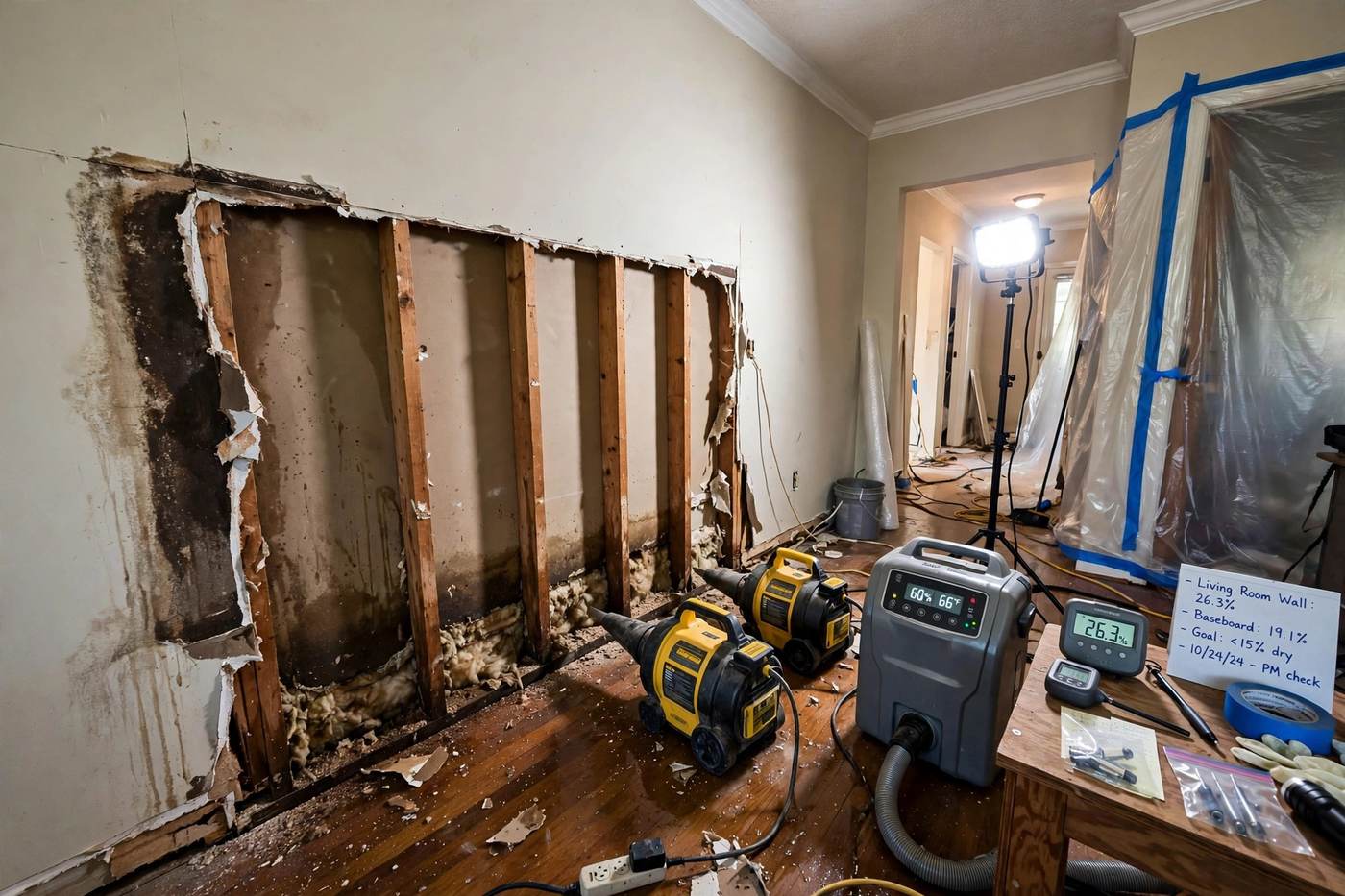
Restoration begins with assessment. A technician walks the home with moisture meters and, where needed, thermal imaging, looking for the full wet boundary — not just the puddle you can see. Water runs under flooring, wicks up drywall, and settles in the insulation under a subfloor. In Goldsboro homes, most of which sit over crawl spaces, that often means checking under the house as well as inside it. Everything wet is photographed and noted, which also creates the record an insurance adjuster will usually ask for later.
Next comes removal. Standing water is extracted with pumps and extraction units, and materials that cannot be dried are taken out — typically soaked carpet pad, swollen particle board, and drywall that has lost its shape. Then drying begins: air movers push dry air across wet surfaces while dehumidifiers pull the moisture out of the air. Drying is monitored with readings taken over successive visits. Only when the readings show the structure is dry does repair start — new drywall, flooring, trim and paint. Rebuilding over damp framing is the single most common mistake in this work, and it is the one this sequence is designed to prevent.
Not all water is the same, and the kind decides what can be dried and what must be removed. Clean water, known as Category 1, comes from a supply line, a broken pipe or a rain leak through the roof. It starts clean, so drying and cleaning are usually enough if the work starts quickly. Grey water, Category 2, comes from appliances — a washing machine, a dishwasher or a bathtub overflow. It carries soaps and organic matter, so cleaning and sanitising matter more, and porous materials soaked in it are often removed rather than dried.
Black water, Category 3, is the serious one: sewage backups and ground-level flood water that has crossed soil, roads and yards. Anything porous that black water touches — carpet, pad, drywall, insulation — is generally removed, not dried, and the remaining surfaces are cleaned and disinfected. Flood water from the Neuse River and storm water that has risen through a slab both count as black water. If you are unsure which kind you have, treat it as the more serious kind until a professional has assessed it, and keep children and pets out of the affected area.
Goldsboro sits on North Carolina’s flat coastal plain, and water behaves differently here than it does on higher, hillier ground. There is nowhere for water to drain quickly, so after a long rain or a river crest the ground stays saturated and gives the water back slowly — sometimes over days. Homes near the Neuse River and on low-lying lots are the most exposed, and the river’s flood stage near Goldsboro is 18 feet, with major flooding at 24 feet. When the river is high, water can sit against foundations and seep in at the lowest point of the house.
Most Goldsboro homes are built over crawl spaces rather than basements, and the crawl space is where a surprising share of the damage hides. A slow supply-line leak, a failed drain, or groundwater rising after a storm can leave standing water on the vapour barrier under the house, soaking insulation and the underside of the subfloor while the rooms above look dry. That is why a proper assessment here almost always includes the crawl space. The other local factor is humidity: Goldsboro summers are warm and humid, and humid air slows drying. Equipment sized for a drier climate will run longer here, and opening windows on a humid day can add moisture rather than remove it.
The first hours decide how big the job becomes. Water spreads fast — across a floor in minutes, into drywall within hours, and down into a crawl space overnight. A leak discovered on a Friday evening and left until Monday is a different job from the same leak dealt with the same night. That is especially true for rental homes around Seymour Johnson Air Force Base, where a leak in a unit sitting empty between tenants can run for days before anyone notices it.
One thing not to do is to start pulling up flooring or cutting drywall before the wet boundary has been mapped. Removing the wrong section wastes time, and removing the right section in the wrong order can spread contaminated water. Assessment first, removal second — that order is what keeps a bad day from becoming a long repair.
The question that matters most at the end of a drying job is not how many days the equipment ran, but what the moisture readings say. Drywall, wood framing and subfloors each have their own normal moisture range, and a technician compares readings in the wet area against readings in a dry part of the same home. Drying often takes several days, and the time varies with the materials involved and the humidity — in Goldsboro’s climate, expect equipment to run longer than it would in a dry region.
When readings are back in the normal range, the equipment is removed and repairs can begin. If readings are still high, drying continues. A home that looks dry and feels dry can still hold moisture inside a wall cavity or under a floor, and that hidden moisture is what feeds mould and odour later. Asking for the final readings, and keeping a copy of them with your photographs, is a reasonable request — and it is the clearest sign the job was finished rather than just stopped.
Standing water removed fast from floors, basements and crawl spaces.
Learn more →It varies with the amount of water, the materials involved and the humidity. Extraction is usually the quickest part; drying often takes several days. In Goldsboro’s humid climate drying can take longer than in drier regions. The work is finished when moisture readings show the structure is dry, not when a set number of days has passed.
Yes. Water from a supply pipe starts clean, while river flood water and storm water that has crossed the ground is treated as black water. Porous materials soaked in black water are generally removed rather than dried, and remaining surfaces are cleaned and disinfected.
It depends on the extent of the damage and the kind of water involved. Small, clean-water jobs in one room often allow you to stay in the home. Larger jobs, sewage contamination, or widespread drying equipment may make staying impractical. A technician can advise after the assessment.
It depends on the source of the water and the terms of your policy. Sudden pipe failures are often covered by homeowners policies, while river flooding generally needs separate flood cover. Keep photographs, moisture readings and a record of what was removed — an adjuster will usually ask for them.
A crawl space is the shallow space between the ground and the floor of a home, common in Goldsboro houses. Water can collect there from leaks, groundwater or storms, soaking insulation and the subfloor while the rooms above look dry. A proper assessment in Goldsboro usually includes checking the crawl space.
The sooner the water is out and the drying starts, the smaller the job. Call now for help in Goldsboro and Wayne County.
📞 Call (919) 555-0140