
Water Damage Restoration
The full restoration sequence — assessment, extraction, drying and repair.
Learn more →Standing water removed fast — from living-room floors, basements and crawl spaces — before it spreads into walls, subfloors and insulation.
When water is standing in a home, the clock is running. Every hour it sits, it spreads: across flooring, up drywall, down through a subfloor and into the crawl space below. Carpet pad soaks through in minutes. Drywall wicks water upward. Wood swells, warps and starts to hold the moisture that mould needs. Emergency water extraction is the first, fastest step in the whole restoration sequence — get the standing water out, then let drying begin.
In Goldsboro, the call for extraction comes from four directions: a burst pipe or failed appliance line, a sewer backup, storm water coming over a threshold or up through a slab, and groundwater rising into a crawl space after long rain. Tropical systems can drop heavy rain far inland here, and on Goldsboro’s flat ground that water has nowhere to go quickly. This page explains how extraction works, what happens in crawl spaces and basements, and what you can safely do while help is on the way.
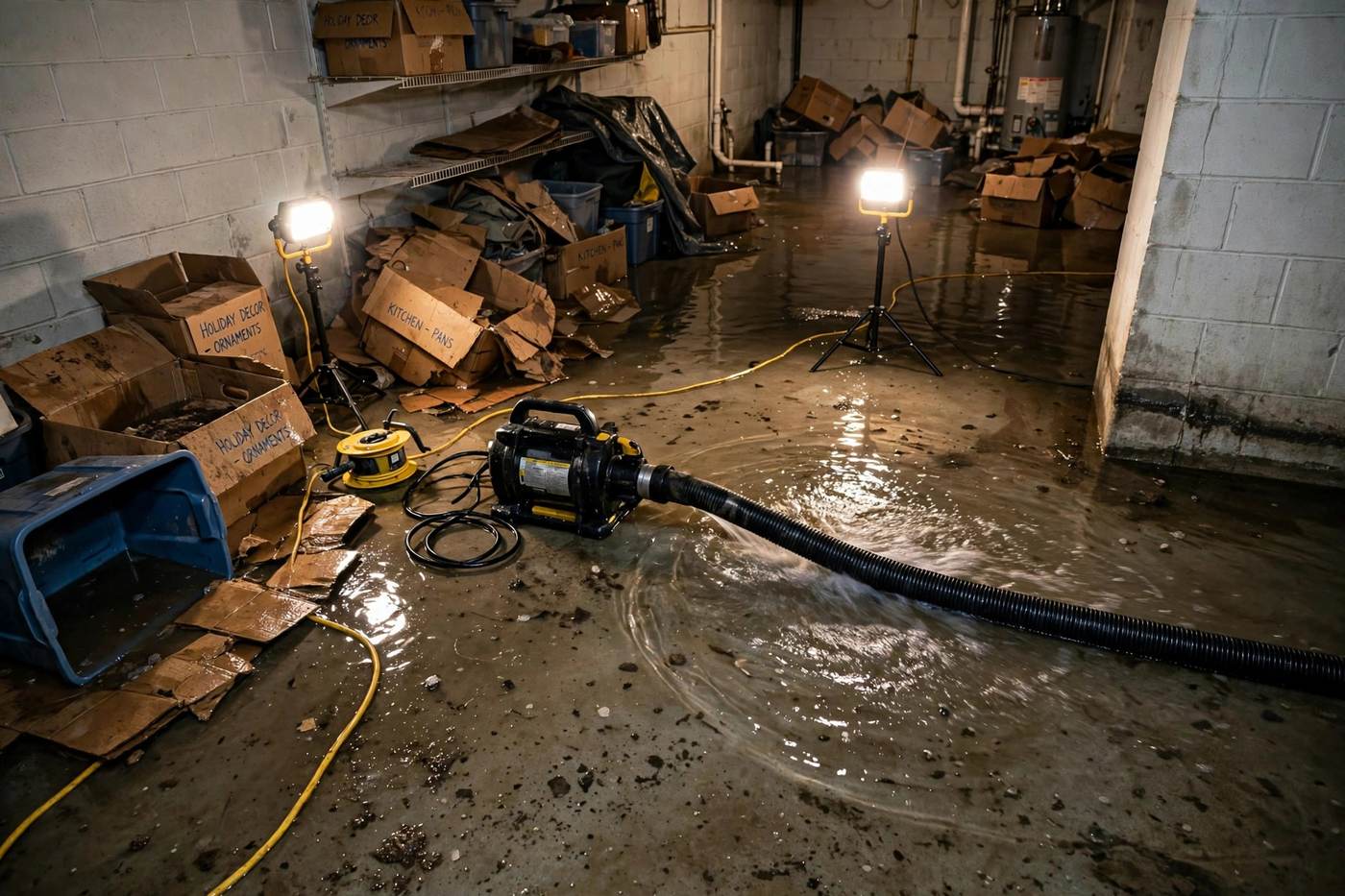
The difference between a wet floor and a ruined floor is often measured in hours. A thin sheet of water on a tile floor is a nuisance. The same water left overnight under a floating floor or behind a baseboard becomes a drying job that takes days, because the water has moved into materials that are slow to give it back. In a crawl-space home, water that reaches the subfloor from below can be worse than water on the floor above — it soaks insulation and the underside of the flooring where nobody sees it.
That is why extraction is treated as an emergency even when the water looks shallow. Removing standing water early limits how far the wet boundary spreads, which limits how much material has to be removed and how long drying takes. It also limits the window for mould, which can begin growing on wet materials in as little as 24 to 48 hours in Goldsboro’s warm, humid air.
Extraction starts with the source. If water is still coming in — a burst supply line, a failed water heater, a washing machine hose — the supply is shut off first. Then the standing water is removed with pumps and extraction units. Submersible pumps handle deeper water in basements and crawl spaces; truck-mounted and portable extraction units pull water out of carpet, pad and hard flooring with strong suction. The choice of equipment depends on the depth of the water and the surface it is on.
As the water comes out, the wet boundary is mapped with moisture meters. This matters because extraction only removes the water you can see. Water that has already wicked into drywall or run under a floor is handled by the drying stage that follows — air movers and dehumidifiers placed to cover the full wet area, not just the centre of the puddle. Photographs and moisture readings taken during extraction become the record of how far the water reached, which is useful if an insurance claim follows.
Most Goldsboro homes sit over crawl spaces, and extraction there is a separate job from extraction in a living room. Water in a crawl space may be standing on the vapour barrier, soaked into insulation, or pooled in low spots under the house. Getting it out means working in a low, dark space with a pump and hose, then removing wet insulation that cannot be dried in place. The framing and subfloor above are then checked with a moisture meter before drying equipment is set up.
Basements are less common in Goldsboro than in northern states, but where they exist they collect water the same way — through walls, up through the floor, or from a failed sump pump. A sump pump that stops during a storm can let a basement fill surprisingly fast, and the first sign is often a damp smell rather than visible water. In both cases the rule is the same: remove the water, find where it came from, and dry the structure with readings, not guesswork.
There is useful work you can do before a crew arrives, and there is work you should leave alone. Moving belongings and documenting the damage are safe and helpful. Wading into contaminated water, opening up walls, or running a shop vacuum on a flooded floor are not. If the water smells of sewage or came in from outside during a storm, treat it as contaminated and stay out of it.
Rental homes around Seymour Johnson Air Force Base deserve a special note. A leak in a unit sitting empty between tenants can run for days before the next family arrives and finds it. Landlords and property managers who check a vacant unit after a tenant leaves — looking at the water heater, the washing machine hoses and the crawl space — often catch these losses while they are still small.
Extraction is the beginning, not the end. Once the standing water is gone, the home still holds moisture in drywall, flooring, framing and insulation, and that moisture has to be dried with equipment and verified with readings. Wet materials that cannot be dried — soaked carpet pad, swollen particle board, saturated insulation — are removed. What remains is cleaned, and in the case of contaminated water, disinfected.
The drying stage is covered in detail on our structural drying page. The short version: air movers and dehumidifiers run until moisture readings in the wet area match readings in a dry part of the same home. Only then is the job ready for repair. If you were told the water is out and the job is done in the same visit, ask for the moisture readings — extraction alone does not dry a home.
The full restoration sequence — assessment, extraction, drying and repair.
Learn more →When the water is sewage or flood water, cleanup needs a different approach.
Learn more →As fast as it safely can be. Water spreads into flooring, drywall and subfloors within hours, and mould can begin growing on wet materials in as little as 24 to 48 hours in warm, humid conditions. Early extraction limits how far the damage spreads and how long drying takes.
A mop can help with a very thin film of clean water on a hard floor. A household vacuum should not be used on standing water — it is not built for it and can be unsafe. Deeper water needs pumps and professional extraction units.
Crawl-space water is common in Goldsboro. It is usually removed with a submersible pump, and wet insulation is generally taken out because it cannot be dried in place. The subfloor and framing above are then checked with a moisture meter and dried with equipment.
No. Water from a burst supply pipe starts clean. Storm water and flood water that has crossed the ground is treated as contaminated black water, and porous materials it soaks are generally removed rather than dried.
Photograph every wet room, the source of the water if you can see it safely, and any belongings that were damaged. Take wide shots of each room and close shots of the worst areas. The photographs help document the loss for any insurance claim.
Do not let it sit. Call now for emergency water extraction in Goldsboro and Wayne County.
📞 Call (919) 555-0140