
Water Damage Restoration
The full sequence — assessment, extraction, drying and repair.
Learn more →Mould follows water fast in Goldsboro’s humid climate. Remediation means containing the area, removing what cannot be cleaned, and drying the structure so it does not come back.
Mould is a water problem wearing a different name. It grows where materials stay wet, and in Goldsboro’s warm, humid air it can begin growing on wet drywall, wood or carpet in as little as 24 to 48 hours. That is why mould is so often found after a leak that went unnoticed — a slow supply-line drip behind a wall, a crawl space that took on groundwater after a long rain, a rental unit that sat empty between tenants at Seymour Johnson Air Force Base while a water heater leaked.
Mould remediation is not a coat of paint and it is not a spray. It is a sequence: find and fix the moisture source, contain the affected area, remove materials that cannot be cleaned, clean what remains, and dry the structure thoroughly. Skipping the drying is how mould returns. This page explains how remediation is done, what gets removed and what can be cleaned, and what North Carolina homeowners should know before work starts.
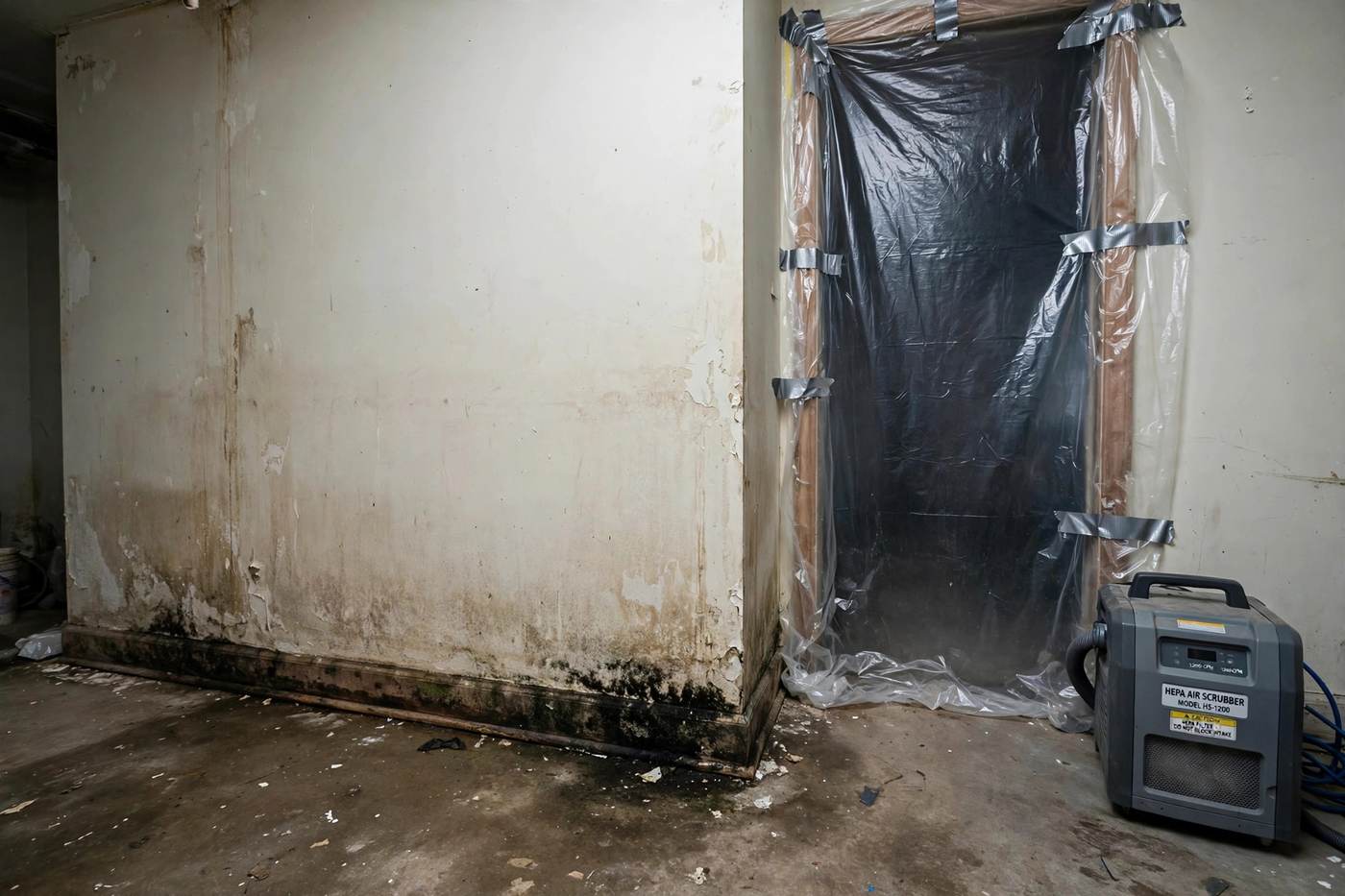
Mould needs three things: moisture, a food source, and time. Goldsboro supplies the first two generously. Drywall paper, wood framing, carpet and dust are all food for mould, and the city’s humid summers keep the air itself damp enough that wet materials dry slowly on their own. A wall that gets wet in January may dry before mould takes hold; the same wall wet in July, with the air already heavy, may not.
The other factor is hiding. Mould often starts where nobody looks — behind a baseboard, inside a wall cavity, under a floor, or in a crawl space. By the time a stain or a musty smell appears in a living room, the growth behind the wall may already be extensive. That is why a moisture meter and, where needed, a look inside the wall matter more than a visual check. If a room smells musty after a leak, or a stain keeps returning after painting, the moisture behind it has usually not been dealt with.
Remediation starts with the moisture source. There is no point cleaning mould from a wall while the pipe above it still leaks or the crawl space below it still holds standing water. Once the source is fixed and the water is out, the affected area is contained — typically with plastic sheeting over doorways and openings — so that spores are not spread through the home during the work. Air filtration equipment is used to capture airborne particles while the work is under way.
Then comes removal and cleaning. Porous materials with heavy growth — soaked drywall, carpet pad, insulation — are generally removed and bagged for disposal. Hard, non-porous surfaces can often be cleaned with appropriate antimicrobial treatments. Framing that remains is cleaned and dried. The work follows recognised industry practice for mould remediation, including containment, filtration and post-work verification. After the visible work, the area is dried and checked with moisture readings, because dry materials are the only lasting defence against regrowth.
The decision turns on the material. Porous materials absorb water deep into their structure, and mould grows through them rather than just on them. Drywall, carpet pad, ceiling tiles and insulation with visible growth are usually removed. That is not wastefulness — it is the practical recognition that cleaning the surface of a soaked material does not reach the growth inside it.
Hard surfaces are different. Wood framing, concrete, metal and tile can generally be cleaned, treated and dried, provided the growth has not rotted the material. Personal belongings are assessed case by case: hard items can often be cleaned, while soft, porous items that were soaked in contaminated water are often discarded. A technician should be able to explain, item by item, why something is being removed or kept — and that explanation should be written down, because it is part of the record for any insurance claim.
North Carolina does not have a single statewide licence specifically for mould remediation. That makes it more important, not less, to ask how the work will be done: what containment will be used, how the area will be dried, and how the result will be checked. A clear written scope — what will be removed, what will be cleaned, what will be dried and how dryness will be verified — is the best protection a homeowner has.
For larger or more sensitive jobs, some homeowners arrange independent post-remediation verification, such as air testing by a separate party, after the work is finished and the area is dry. Whether that is appropriate depends on the size of the affected area and the sensitivity of the people in the home. What matters most is that the moisture source is fixed and the structure is dry. Remediation without drying is a pause, not a solution.
Mould returns when moisture returns, so prevention is part of the job. After remediation, the habits that matter most in Goldsboro are simple: fix leaks promptly, check the crawl space after long rain, keep gutters discharging away from the foundation, and keep indoor humidity in check with ventilation and, where needed, dehumidification. A crawl-space vapour barrier that is torn or displaced lets ground moisture into the house all year.
Watch for the early signs after any water event: a musty smell that appears when the air conditioning cycles, a stain that returns on a wall or ceiling, or paint that bubbles and peels. Any of those means moisture is still present somewhere, and finding it early is far easier than dealing with a second round of growth. If you have had water damage and are unsure whether the area dried properly, a moisture check is a reasonable next step.
The full sequence — assessment, extraction, drying and repair.
Learn more →Drying verified by moisture readings, so mould has nowhere to return to.
Learn more →Fast removal of standing water limits how much mould can grow.
Learn more →In warm, humid conditions mould can begin growing on wet materials in as little as 24 to 48 hours. That is why fast extraction and thorough drying matter so much in Goldsboro. The longer materials stay wet, the more likely mould becomes.
No. Paint covers the stain but does not remove the growth or fix the moisture that caused it. The mould usually returns through the new paint, and the damp material behind it keeps deteriorating. The moisture source must be fixed and the affected material cleaned or removed.
North Carolina does not have a single statewide licence specifically for mould remediation. Ask for a clear written scope of the work — what will be contained, removed, cleaned and dried, and how dryness will be verified — before work starts.
It depends on the extent of the growth and the sensitivity of the people in the home. Small, contained areas are often dealt with while the household stays in place. Larger growth, or growth affecting bedrooms and living areas, may need the area sealed off during the work. A technician can advise after an assessment.
The signs are the absence of visible growth and odour, and moisture readings in the normal range for the materials involved. For larger jobs, some homeowners arrange independent post-remediation verification after the area is dry. Drying is the key — dry materials do not support regrowth.
Find the moisture, contain the area, remove what cannot be cleaned, and dry it properly. Call now for help in Goldsboro.
📞 Call (919) 555-0140