
Water Damage Restoration
The full sequence — assessment, extraction, drying and repair.
Learn more →Drying is not a matter of time — it is a matter of readings. Air movers and dehumidifiers run until moisture meters show the structure is dry, in a climate that makes drying harder than most.
After the standing water is gone, a home is still wet. Drywall holds moisture, wood framing holds moisture, subfloors and insulation hold moisture — and none of it is visible. Structural drying is the stage that deals with that hidden water: air movers push dry air across wet surfaces, dehumidifiers pull the moisture out of the air, and moisture meters track the progress until the readings say the structure is dry.
In Goldsboro, drying is harder than in most towns. The air itself is humid for much of the year, so equipment has to work against the climate as well as the wet materials. Opening windows on a humid day can add moisture rather than remove it. This page explains how drying is done, how it is measured, and why the readings — not the calendar — decide when the job is finished.
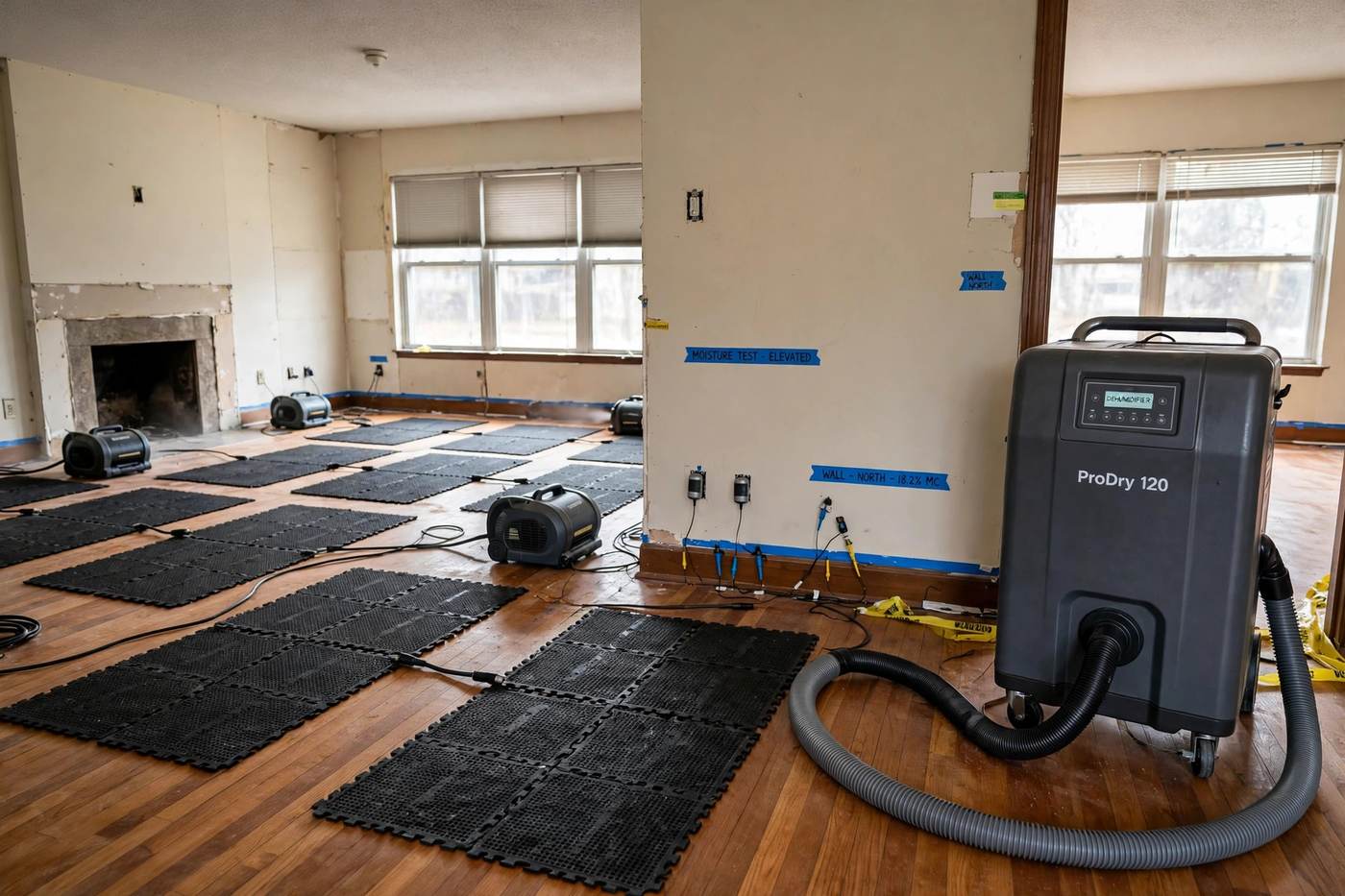
Drying has two parts: moving air and removing moisture from that air. Air movers — the low, wide fans you see in a drying job — push a fast stream of air across wet walls and floors. Moving air evaporates moisture from the surface far faster than still air does. Dehumidifiers then pull that moisture out of the air and drain it away, so the air stays dry enough to keep evaporating. The two work as a pair: air movers without dehumidification just move damp air around, and dehumidifiers without air movement dry the air but leave the surfaces wet.
Placement matters as much as the equipment itself. Air movers are aimed at the wet surfaces — along a wall, across a floor, into a wall cavity where drywall has been opened — and the number of units is matched to the size of the wet area. In a crawl space, drying equipment is set up under the house as well as in the rooms above. The layout is checked and adjusted as readings change, because a room dries unevenly: the centre dries first, the corners and the base of the walls last.
The central question in drying is what counts as dry. The answer comes from moisture meters, not from touching a wall. Drywall, wood framing and subfloors each have their own normal moisture range, and a technician compares readings in the wet area against readings in a dry part of the same home — the same materials, the same house, the same day. When the wet readings have returned to the dry range, the structure is dry.
Readings are taken over successive visits, because drying is not linear. The surface dries first and the core of the material later, so a wall that reads dry on the surface may still be wet inside. That is why equipment is left running even after the room looks and feels dry, and why a job that stops early so often ends with a musty smell a few weeks later. If you are told a home is dry, it is reasonable to ask for the final readings — and to keep a copy of them with your photographs.
Drying in Goldsboro runs against the climate. Warm, humid air holds a lot of moisture already, so a dehumidifier has to work harder to pull more out, and wet materials give up their moisture more slowly. A drying job that might take a few days in a dry climate often takes longer here, and the difference is not a matter of effort — it is a matter of physics. Equipment sized for a drier region will run longer in Goldsboro, and that is normal.
The practical consequence is that shortcuts do not work here. Opening windows on a humid summer day lets damp air in. Turning the equipment off overnight because it is noisy lets the moisture climb back. Running a household fan instead of an air mover does not move enough air across the surface. Drying in this climate needs the right equipment, placed correctly, left running until the readings say stop.
Different materials dry at very different speeds. Drywall dries relatively quickly once the wet section is opened up, because air can reach both faces. Hardwood floors are slower: water gets between the boards and under them, and the floor may cup or buckle before it dries. Subfloors and framing dry slowly because they are thick and often covered. Insulation is the slowest of all — wet fibreglass insulation in a wall or a crawl space usually cannot be dried in place and is generally removed.
Concrete is its own case. A slab that has been flooded can hold moisture for a long time, and it releases that moisture slowly into anything laid over it. Flooring laid over a damp slab will fail. That is why a slab is checked with a moisture meter before new flooring goes down, even if the surface looks dry. The rule across all materials is the same: the reading decides, not the appearance.
A home that is rebuilt over damp materials will usually announce the mistake within weeks. Paint bubbles and peels. A musty smell appears when the air conditioning cycles. Flooring cups or lifts. Mould grows in the wall cavity where nobody can see it until the stain comes through. Each of these is more expensive to fix than the drying that would have prevented it, because the repair has to be undone and redone.
That is the real purpose of the drying stage: it protects the repair. Every dollar and day spent on drying is insurance for the work that follows it. If a schedule is pressing — a family waiting to move back in, a rental that needs to turn over — the temptation is to rebuild early. Resist it. A few more days of drying is a small delay against a second round of demolition. When the readings are right, the repair can begin with confidence, and the home stays dry afterwards.
The full sequence — assessment, extraction, drying and repair.
Learn more →It varies with the materials involved, how much water there was, and the humidity. Drying often takes several days, and in Goldsboro’s humid climate it can take longer than in drier regions. The work is finished when moisture readings show the structure is dry, not when a set number of days has passed.
In Goldsboro’s humid climate, opening windows on a warm, damp day can let more moisture in rather than taking it out. Controlled drying uses air movers to move dry air across wet surfaces and dehumidifiers to pull the moisture out of the air.
With a moisture meter. Readings in the wet area are compared against readings in a dry part of the same home, using the same materials. When the wet readings have returned to the normal range, the structure is dry. Touch and appearance alone are not reliable.
Usually not. Wet insulation in a wall or a crawl space generally cannot be dried effectively in place and is usually removed. The framing behind it is then dried and checked with a moisture meter.
Paint can bubble and peel, flooring can cup or lift, and mould can grow inside wall cavities. The repair then has to be undone and redone, which is more expensive than the extra drying time would have been.
Looks dry is not dry. Call now for moisture-checked structural drying in Goldsboro and Wayne County.
📞 Call (919) 555-0140